Mongolia Catheter Intervention Support Activities
12/25/2025
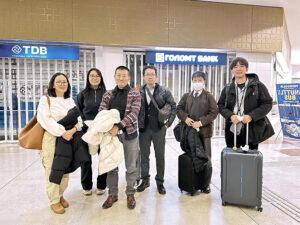
Arrival at Chinggis Khaan International Airport
November 2025
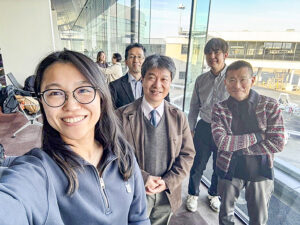
From November 21 to 24, 2025, the catheter intervention team of the Heart Saving Project visited Ulaanbaatar, Mongolia, and conducted pediatric cardiology clinical support activities at the National Center for Maternal and Child Health (NCMCH).
This project has been carried out on a continuous basis with the dual aims of providing clinical support and fostering local human resource development. Following our activities in May and August, this visit marked the third catheter intervention support mission of the year, and this report summarizes the outcomes of the November mission.
Schedule
November 21 (Thu), 2025
Departed Narita Airport at 15:30 on MIAT Mongolian Airlines; arrived at Chinggis Khaan International Airport at 20:35 (approximately 1.5 hours to the city center thereafter).
November 22 (Fri), 2025
Morning: Cardiac echocardiography screening for 96 patients at the National Center for Maternal and Child Health (NCMCH).
Afternoon: 3 therapeutic catheter interventions and 1 diagnostic catheterization.
November 23 (Sat), 2025
Morning rounds; from late morning onward, 10 therapeutic catheter interventions were performed.
A comprehensive conference was held following the completion of procedures.
November 24 (Sun), 2025
Departed hotel in the morning. Returned to Japan on MIAT Mongolian Airlines (08:55 departure from Chinggis Khaan International Airport; arrival at Narita at 14:30). The team dispersed at the airport.
Team Members
Team Leader:
Dr. HideshiTomita, Chairman (Showa Medical University Hospital)
Physicians:
Dr. Hirotaka Oki (Tokyo Metropolitan Children’s Medical Center)
Dr. Tadaaki Abe (Niigata University Medical and Dental Hospital)
Dr. Toshiyuki Chisaka (Ehime University Hospital)
Dr. Natsumi Kikuchi (Showa Medical University Hospital)
Secretariat:
B. Tuya
Outsomes of This Mission
Cardiac echocardiography screenings: 96 patients
Diagnostic catheterization: 1 case
Patent ductus arteriosus (PDA)
Therapeutic catheter interventions: 13 cases, including:
PDA: 4 cases
Pulmonary valve stenosis (PS): 1 case
Atrial septal defect (ASD): 7 cases
Pulmonary atresia with intact ventricular septum (PA/IVS): 1 case
Activity Details
The team arrived in Ulaanbaatar on the evening of November 21. Upon arrival, we were kindly invited to dinner by former Yokozuna Harumafuji at the chanko-style restaurant “TSUNA Restaurant” in Ulaanbaatar.
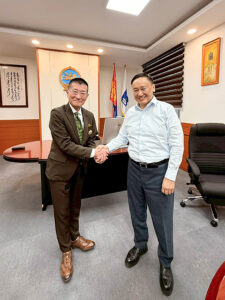
Minister J. Chimburen of the Mongolian Ministry of Health (right) and Chairman Tomita (left)
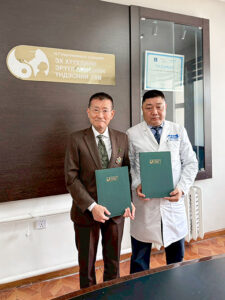
Minister J. Chimburen of the Mongolian Ministry of Health (right) and Chairman Tomita (left)
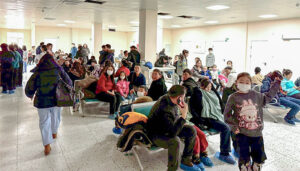
Many patients and their families were waiting
On November 22, cardiac echocardiography screenings began in the morning. During this time, Dr. Tomita met separately with Minister J. Chimburen of the Mongolian Ministry of Health to explain the Heart Saving Project’s activities. He also raised concerns regarding the complexity of the procedures required to obtain certification for foreign physicians participating in medical activities.
As the Minister has prior experience studying at a Japanese medical university and has also invited European physicians to Mongolia for surgical procedures, he demonstrated a clear understanding of the situation and agreed to pursue simplification of these procedures.
Following this meeting, Dr. Tomita also met with Mr. J. Otgonbaatar, Director of NCMCH, to complete the renewal process of the cooperation agreement for Heart Saving Project activities at NCMCH.
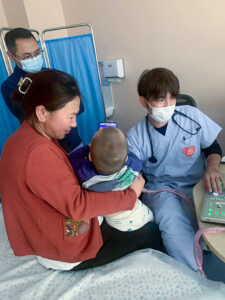
On the morning of November 22, a large number of patients and family members seeking treatment gathered in the hospital waiting area. Because the echocardiography examinations that began in the morning could not be completed by noon, the team divided into two groups in the afternoon: one continued echocardiography screenings, while the other provided instruction and support to local physicians performing catheter interventions.
In total, 96 echocardiography screenings were completed.
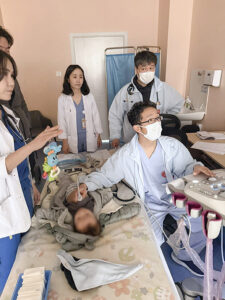
Dr. Abe participated for the first time
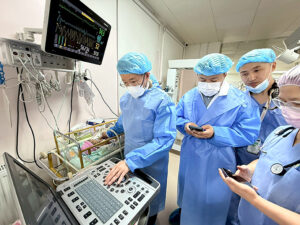
Dr.Chisaka participating for the third time
The catheterization procedures on this day were tough
On the same day, four catheter interventions were performed. The final therapeutic catheter procedure concluded at 10:30 p.m., and as a result, no conference was held that evening. The team completed cleanup and left the hospital shortly after midnight.
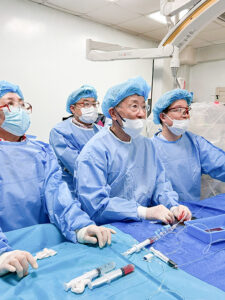
catheter treatment on 22nd
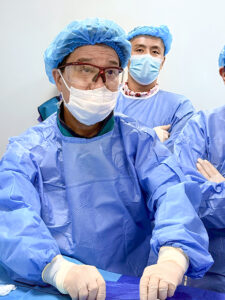
Dr.Ooki is the second participating

(from light) Dr.Borolmaa of NCMCH,Dr.Hirotaka Ooki, Dr. Hideshi Tomita, Dr.Khongol of NCMCH
On November 23, catheter interventions were performed continuously from 8:00 a.m. until 9:30 p.m., with 10 cases completed that day.
Of the 14 total catheter interventions performed over the two days, with the exception of some cases on the first day, the procedures—including device deployment—were primarily led by Mongolian physicians, with Japanese physicians providing guidance and support. The technical proficiency of the local physicians has been improving steadily, and the results of continued collaboration since the post-COVID period were clearly evident.
Due to the late completion of procedures on this day as well, the conference was held in the staff lounge while sharing delivered meals.
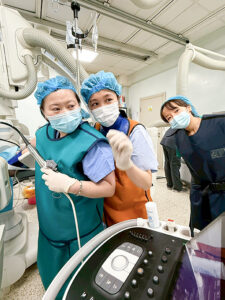
Dr. Kikuchi instructing TEE
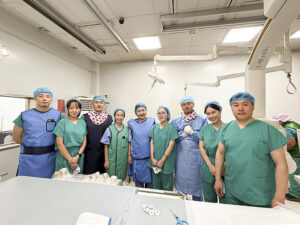
team stuff of NCMCH(Mongolia)
Prior to this visit, maintenance of the angiography system was requested in advance. As a result, the frequent equipment malfunctions experienced during the summer visit did not occur, allowing procedures to be carried out in a stable environment.
However, limitations in medical supplies remain a significant challenge. The types and quantities of available devices and guidewires are still restricted; coils are in short supply, ASD devices were depleted midway through the mission, and even basic medications are not always available. In some cases, families reportedly obtain necessary medications privately from abroad (e.g., Russia) and bring them to the hospital for use, with hospital approval. These issues once again highlighted the ongoing challenges related to material resources.
In addition, there is a shortage of personnel capable of actively performing transesophageal echocardiography (TEE). As this technique is still under development locally, ASD interventions are currently performed only when Japanese teams are present. In Mongolia, TEE is used exclusively for ASD treatment, and while interest in becoming catheter operators is high, there are currently no staff members expressing a desire to specialize in TEE.
Considering that a cardiovascular surgery department is scheduled to open at NCMCH in the near future and in-house surgical procedures will begin, the training and development of TEE specialists will be a crucial challenge moving forward.
The high number of cases treated during this visit can be attributed to several factors:
1.Many patients traveled from remote regions, making the timing of their next visit uncertain (a situation unique to Mongolia’s vast geography).
2.A backlog of untreated cases from previous years remained, as patients with higher urgency had been prioritized due to device shortages.
3.Patients over 17 years of age are considered adults and face higher medical costs, leading many families to seek treatment before reaching the age threshold for economic reasons.
During the stay, no outbreaks of infectious diseases were observed among patients. However, influenza was prevalent among local medical staff, and several staff members experienced illness.
The anesthesia team consisted of two anesthesiologists. (In August, only one anesthesiologist was available, which created significant time and workload challenges.) To shorten procedure times, anesthesia induction was performed in a separate room, and various adaptations were made within the constraints of the limited environment.
At NCMCH, a new operating room and a four-bed postoperative ICU for cardiovascular surgery have been established with support from Luxembourg, and full-scale operations are scheduled to begin after the New Year. However, training of surgical staff is only now beginning in earnest.
Through this mission, we once again recognized the high level of clinical skill and strong motivation to learn among local physicians, while also clearly identifying structural challenges related to medical resources, staffing, and medication supply. With the continued support of our partners and supporters, we will remain committed to ongoing cooperation that contributes to the sustainable and independent development of pediatric cardiology care in Mongolia.
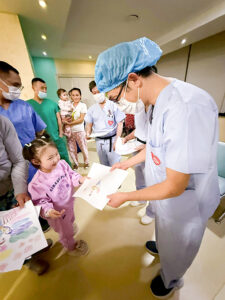
The patient presented us with a picture she had drawn herself
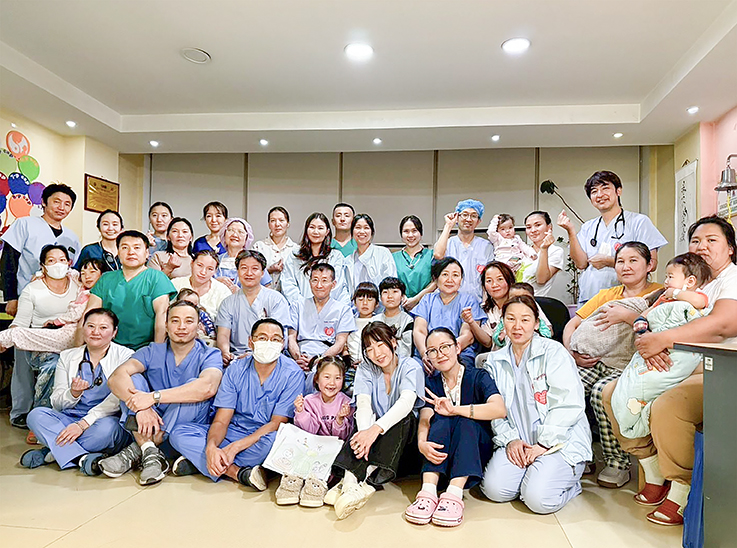
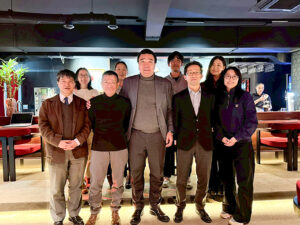
Patients who received treatment, their families, Heart Saving staff who participated in this event, and local staff from a cooperating NPO in Mongolia
Closing Remarks
Among the five physicians who participated in this mission, one joined for the first time. Below are selected comments from the participants:
“For about three days after returning home, I kept reliving the hardships of Mongolia in my dreams. It was tough, but it was also a lot of fun.”
“It was exhausting due to the high number of cases in such a short time, but I really enjoyed it.”
“In Mongolia, I felt that the distance between healthcare professionals and patients is very close.”
“Working collaboratively with colleagues from different institutions allowed me to learn a great deal about different approaches and practices.”
“We returned so late every night that I couldn’t see the starry sky I had heard about. I’d like to participate again and see the stars and grasslands next time.”
(Secretariat’s note: We would like to make time for that on your next visit, although schedules are usually very tight. This time, with temperatures below –15°C, traveling outside the city would have required heavy winter equipment, making it difficult.)
To all participants and to everyone who continues to support this project, we extend our sincere gratitude once again.
We kindly ask for your continued support and cooperation in 2026 as well.